Events с Stela Gancheva
Info - Stela Gancheva:
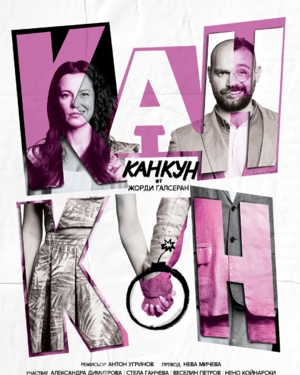
Stella Gancheva is an actress whose name is increasingly recognizable as a living presence on the contemporary Bulgarian stage. She works with that steady focus that the audience instinctively recognizes from the very first appearance – dedication to the partner, precision to the text and a clear sense of stage time. In her professional path, the theater is the natural environment in which acting is assembled from careful, often invisible at first glance decisions: how to build a character through detail, when a pause tells more than a line, how silence can become a dramatic accent. In this context, one of Gancheva's public appearances is in the production of "Cancun" – a contemporary play woven from irony, wit and human vulnerability, in which the ensemble play is key to the impact on the viewer. The audience can see her there, in a team that works together to convey the complex mix of humor and moral questions embedded in the dramaturgy of the text.
Cancún – a contemporary comedy of manners with a subtle psychological lens
“Cancún” by Jordi Galcerán is a play that quickly found its way to European stages with its attractive plot and intelligently constructed dialogues. The story places four close friends in the seemingly harmless situation of a joint vacation – a backdrop that gradually unravels and becomes a terrain for confessions, alternative versions of the past and doubts about seemingly safe life choices. The text is saturated with humor, but it does not serve as frivolous entertainment; rather, it acts as a device that lowers defenses and allows the characters – and the audience – to look at themselves more honestly. For an actor like Stella Gancheva, such a production provides an ideal territory for precise dosing of tempo-rhythm, for careful listening in partner scenes and for that kind of stage candor in which the comedic effect is born from credibility, not from external tricks. In "Cancun" the balance between laughter and insight is delicate and requires from each participant in the ensemble a virtuoso sense of proportion – to remain simultaneously funny and real, witty and compassionate. It is here that the mature approach to the craft is evident: to subordinate the acting decisions to the rhythm of the common story.
Ensemble, partnership and stage trust
When watching a performance in which four actors carry the entire world of the play on their shoulders, attention inevitably focuses on the quality of the ensemble acting. In this sense, Stella Gancheva's participation in "Cancun" speaks of trust - trust between the actors, between the actor and the director, and, last but not least, between the stage and the audience. This play is built on partner scenes, in which nuances are of key importance: how a line is built upon, how the point of view changes within the same conversation, how the comic opens the door to the painfully recognizable. The actor must be precise not only in the text, but also in the silences - those short pauses in which the audience "breathes" along with the characters. For this mechanism to work, everyone in the team must have a stage presence without unnecessary demonstration, hear their partner and give them signals in time. Such work often remains invisible, but it is precisely this that distinguishes performances that remain in the memory not with spectacles, but with human fidelity to situations and relationships.
In a performance like "Cancun", genre elasticity is a basic requirement: comedy requires precise rhythm, and the dramatic layers must be directed without pathos. For the actress, this means exploring the motives of her character through the eyes of a person, and not through the schemes of the genre. As a result, the audience finds itself in that special theatrical climate in which laughter does not cancel the seriousness of the questions - on the contrary, it makes them more accessible. There, the actor's job is to preserve the authenticity of the moment: not to succumb to the temptation to "outdo" the text, nor to turn the stage into a moral tribune. These are fine boundaries that are upheld with discipline and flair, and they give the actor's style depth without burdening it with unnecessary showiness.
For the audience, the surest starting point for Stella Gancheva's work today is precisely the performance "Cancun", where one can trace how she fits into the common breathing of the team and how she defines her stage tone through partnerships. When four actors share a stage space for more than an hour, even small gestures become visible: how the timbre changes at a key moment, how the gaze overtakes the words, how the crescendo of the comedy pours into unexpected silence. It is in these details that the theater shows its greatest appeal - and there the actress finds her contribution. For viewers looking for a contemporary text, staged with respect for the human dimensions of laughter and choice, the performance is a natural choice. Information about dates and scenes and the opportunity to purchase tickets can be found here: Cancun.
In the urban cultural environment, where the rhythm often requires quick decisions and short-term commitments, "Cancun" provides an opportunity to observe a process in which collaboration and the careful construction of a stage language are placed at the center. For Stella Gancheva, this participation is an important visible step - not as a separate achievement, but as part of a broader responsibility to the theater audience: to present stories that are both accessible and intelligent enough to leave a mark. There is no need for loud gestures here; there is a need for precision, discipline and human measure - qualities that the audience relies on effortlessly. Ultimately, it is through such roles that theater retains its ability to speak about the present without a raised tone, with the confident softness of a well-told story in which every viewer finds something of their own.