
No tickets available
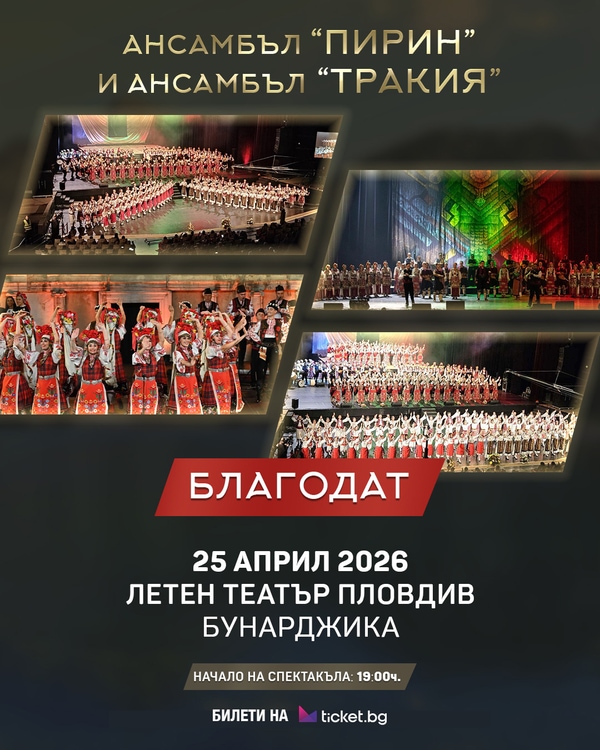
Spektakal Blagodat
Ensemble Pirin and Ensemble Thrace gather on one stage to present the impressive spectacle "Blagodat" - a celebration of the Bulgarian spirit, tradition and strength.
Expect captivating choreography, powerful voices, authentic music and energy that goes straight through the heart. "Blagodat" is a story about our roots, about the beauty of folklore and about the living connection between the past present.
When two of Bulgaria’s flagship folk companies meet, the stage becomes a living atlas of regions and styles. Ensemble Pirin, founded in 1954 in Blagoevgrad, brings the blend that made it a touring powerhouse with thousands of concerts worldwide: a women’s choir famed for open-throated harmonies, a tight folk orchestra, and a precision dance troupe. Ensemble Trakia, created in Plovdiv in 1974 by the legendary choreographer Prof. Kiril Dzhenev, arrives with a signature theatricality and sculpted line that generations of Bulgarian dancers have studied. Today the ensemble is led artistically by Prof. Daniela Dzheneva, and its musicians, singers and dancers continue to tour across continents.
Expect a program that moves across folklore regions—Pirin, Thrace, Shopluk, Rhodopes, Dobrudzha and Strandzha—through authentic melodies, stylized stage suites and virtuoso footwork. The orchestras color the evening with kaval, gaida, gadulka, tambura and tupan; these timbres drive the asymmetric rhythms that make Bulgarian music instantly recognizable. One minute you’ll hear the buoyant 7/8 of rachenitsa, the next the rocking 9/8 of daichovo or the crackling 11/16 of kopanitsa, as lines of dancers snap into unison, break apart for showpiece solos, and re-form into sweeping chains.
The title “Blagodat” carries special weight. It headlined Pirin’s 70th‑anniversary gala in Sofia and now returns as a shared canvas for two national institutions to converse on stage: Trakia’s clean, architectural phrasing against Pirin’s mountainous drive; intimate a cappella passages blooming into massed-choral climaxes; village ritual turned contemporary stage language. Look, too, for the costumes: hand-embroidered aprons and vests from distinct regions, silver adornments that catch the light, and vividly patterned sashes that sketch motion even in moments of stillness.
Why the Summer Theater matters
- The open-air amphitheater at Bunardzhika in Plovdiv offers clear sightlines and naturally resonant acoustics—ideal for antiphonal choral effects and the stomp of big ensemble finales.
- Renovated in the 2000s, it seats around 2,500, balancing scale with a close connection to the performers.
Audiences new to Bulgarian folklore will find this a fast track to the essentials: the communal energy of the horo, the vocal shimmer of close intervals, and choreography that tells stories without a single spoken word. Longtime fans will catch historical nods—the Dzhenev school of staging, emblematic dance models refreshed by today’s masters—and the joy of two storied troupes answering each other in song and step.
If live music is your season theme, explore more upcoming shows alongside “Blagodat”: Lubo Kirov 2026, Concert of B.T.R. and Miro 2026.
Folklor
120 min.
Children