Events с Dimitar Jivkov
Info - Dimitar Jivkov:
Dimitar Zhivkov is a Bulgarian actor who, over the past decade, has managed to turn closeness to the audience into his distinctive brand. He attracts attention with stage projects in which the plot is born live – from the pace of speech, from rapid transformations, from observational humor and from that human warmth that makes theater necessary. His name is associated with the monologue format – a difficult territory, where the actor is simultaneously the engine of the action, the bearer of multiple characters and a conversational partner of the audience. Zhivkov maintains a lasting reputation as an artist for whom the stage is not a podium, but a place for meeting – not only with the characters who come to life through him, but also with the people on the other side, who have come to hear their own voice, told with artistic measure and an intelligent smile.
Even with his first widely performed one-man shows, Zhivkov declared an affinity for stories that see the funny and the touching as two sides of the same human effort to be understood. He is able to condense entire biographies into a short stage situation, to build a character with two or three strokes – a change in posture, a new timbre, a small habit – and immediately place him in a common orbit with the other characters. This approach is not read as an actor's showmanship, but as a subtle direction of attention: he arranges the characters so that they "talk" to each other through his body and voice. Zhivkov works with precision to the detail: articulation, rhythm, pause. It is these tools that allow him to smoothly move from observational irony to very serious topics – without disturbing the good tone of the stage conversation.
Zhivak and the path to the monologue formatAmong the projects that solidify his name, a special place is occupied by "Zhivak" – a title that has become a byword for the actor's ability to inhabit entire galleries of images and tell the story of Bulgaria through its small but telling habits. "Zhivak" lives on various stages in the country, and meetings with audiences outside the largest cities are an important part of the biography of this spectacle. It is there – in community centers, chamber stages, cultural centers – that what Zhivkov stands for is most clearly seen: that comedy is not an escape from seriousness, but a way to look the truth in the eye without turning away. The success of this one-man show establishes the actor as one of the brightest representatives of the form, which requires iron discipline and a willingness to carry the entire performance alone – from the first breath of the beginning to the last silence before the applause.
The work on "Zhivak" also sculpts Zhivkov's stage style: he builds a narrative from small, seemingly insignificant observations – intonations, gestures, everyday details – which gradually connect into a larger picture. Thus, the actor does not simply "play" characters, but creates a social topography of voices and points of view. It is this attitude to the material – careful, unobtrusive, but unerringly in focus – that makes his work recognizable and consistently sought after.
Stage style and presenceWhen we observe Dimitar Zhivkov on stage, his ability to set the rhythm of the evening is impressive. He uses language like music: he knows when to speed up, when to lower the tone, when to stop, to give the funny a chance to be “born” and the serious a chance to remain. The visual simplicity of the stage environment, which often accompanies his work, is not a coincidence, but a conscious choice: the fewer objects stand between the actor and the viewer, the clearer the lines of the performance. This clarity does not exclude play - on the contrary, it allows improvisational “plugs” to be plugged in where they are most needed. His meetings with the audience are lively - in them there is room for reaction, for laughter, for a short line from the hall that can change the angle without disrupting the structure of the performance.
Zhivkov's repertoire develops organically: new titles do not cancel the previous ones, but continue them in a different direction. He does not “replace” themes, but rearranges them so that each subsequent performance adds a new nuance to the portrait of the same society – the same one that laughs at its own habits and asks itself difficult questions on the way home.
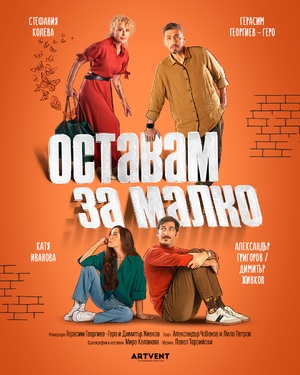
“I’ll Stay for a While” – a Meeting That Changes the PaceIn this context, the play “I Stay for a Little While” has a special place – a production that brings together Zhivkov’s characteristic worlds: a delicate sense of humor, empathy for the characters, a desire for lively dialogue and discipline of stage form. The title promises a short stop, but in the theater “a little” often means exactly the time we need to look around. In “I Stay for a Little While”, the actor uses the experience gained from his previous projects to draw attention to transitional states – the moments when you are not “here” and “there”, but in the middle; when words catch up with thoughts, and the funny and the serious lend a hand. The play is performed on various stages in the country and is part of his active repertoire, with meetings with the audience preserving the intimate, almost conversational atmosphere so characteristic of his work. For dates and locations of upcoming performances, you can follow the title Staying for a Little While.
The stage structure of "Staying for a Little While" is clear and open to the audience's reaction. The actor uses minimal means – voice, body, well-distributed pauses – to achieve density of the narrative. There is his characteristic tendency towards quick, focused transitions between images; towards speech plasticity that does not seek effect, but clarity; towards detail that does not dominate, but arranges. All of this works in the service of that naturalness that the audience recognizes: to hear the language of their own everyday life, translated into a stage timbre, without losing the accuracy of the meaning.
The way in which Zhivkov "assembles" the evening shows his behavior as a responsible partner – towards the text, towards the viewer, towards the companions in the process. Even when he is alone on stage, you can feel a team behind him: a director's eye, dramaturgical discipline, technical care. This collegial culture is also evident in the acting itself: he has a sense of when to slow down the scene to give the emotion a chance to "come home", and when to speed it up to refresh attention. In other words, "I'll Stay for a While" stands as a natural continuation of his previous path - not as a repetition, but as a development of themes that prove to be sustainable even today.
When talking about Dimitar Zhivkov's place in contemporary Bulgarian theater, we must take into account one important feature: he combines the mobility of the independent stage with the sense of responsibility that is traditionally associated with repertory theater. His performances "travel" - and thereby overcome the geographical conventions that often divide the cultural map. At the same time, every meeting is equal, regardless of whether it is on a prestigious metropolitan stage or in a smaller town. It is this accessibility – understood not as a compromise, but as the quality of the conversation – that keeps the interest in his work alive.
Today, Zhivkov is among those actors who defend the stage as a space for meaningful, but also pleasantly surprising events. He does not get carried away by spectacular exaggerations; he prefers precise work in which trust in the audience is the leading factor. He knows how to pose topical questions without being declarative, while at the same time preserving the ease of communication – precisely that “light air”, without which comedy turns into either sarcasm or noise. In his performances, the viewer comes away with the feeling that he has met familiar people – perhaps neighbors, perhaps himself – and that this recognition is both funny and instructive.
The time that Dimitar Zhivkov spends on stage is not just a professional biography; it is also a territory in which words and gestures leave a mark. From "Zhivak" – with its gallery of voices – to "Ostavam zo malko", where transience becomes a theme and a rhythm, the actor upholds the claim that theater is as much art as it is communication. And that when an artist brings with them precision, cordiality and a sense of proportion, the audience doesn't just applaud – they stay for a while to look around, smile and leave different.