No tickets available
Vinovniyat
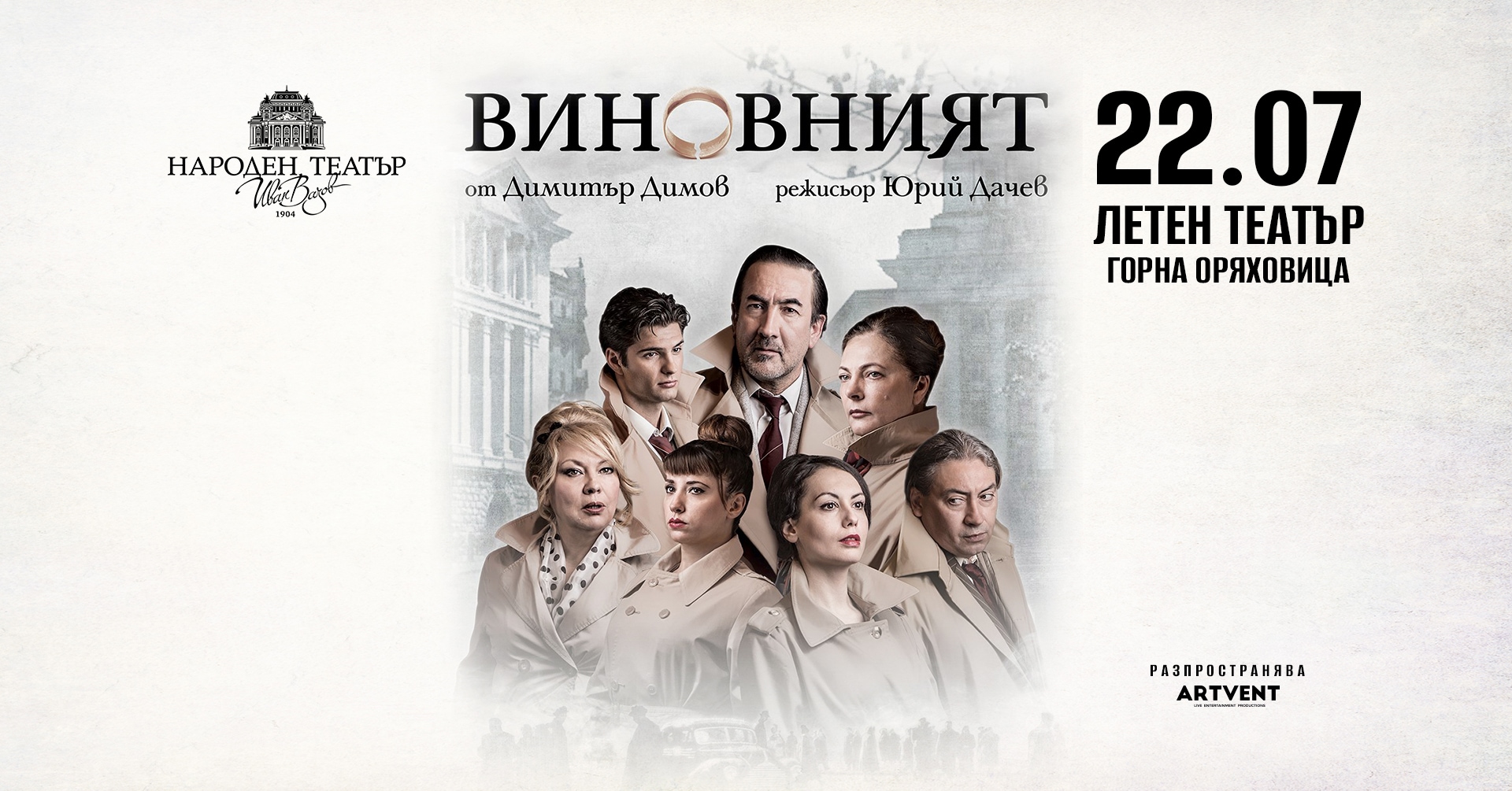
A bitter comedy of manners, in which the director skillfully confronts actors and audiences with the question – are we or time the „guilty one” and invites everyone on a journey toward themselves with the charm of the bygone high life of old Sofia, with a whiff of love and theatricality, with the truth that we are all inclined to tell others only what we cannot hide. „The Guilty One” is a play in which the characters often repeat: „The times were like that“. They utter it as an explanation, an excuse, an exoneration… This attempt to shift onto time the responsibility for our own compromises is, in fact, a rather convenient role that we perform for ourselves. Only no era is guilty enough to make us completely innocent. Dimitar Dimov writes „The Guilty One“ in an era hunched under guilt. Among its many monstrous distortions belongs one that we seem to have forgotten most easily: the hypocritical peremptoriness with which we deny or disregard the unpredictable power of feelings. The characters in this story collide with fears, constraints, illusions and clichés from the late 1950s. A strange, very solitary play in Bulgarian drama is „The Guilty One“, notes Yuri Dachev. With the inexplicability of the attraction between the characters, with the inevitable catastrophes, with the unspoken revelations. But our continuing misunderstanding regarding the apportioning of guilt: our own and the other – of time, makes this text alive and contemporary.
Dimitar Dimov’s rarely staged salon play returns to the repertoire with a brisk, 90‑minute staging that thrives on close‑up acting and razor‑edged dialogue. First premiered at the Ivan Vazov National Theatre on 26 December 1961, the text resurfaced on the same stage on 12 January 2018 in a new reading that brings the post‑war, late‑1950s milieu into sharp focus without treating it as museum décor. It’s intimate, tense, and uncomfortably funny.
The production is led by director Yourii Dachev, whose taste for psychologically precise, actor‑centered theatre anchors the evening. Visual identity comes from scenographer and costume designer Radina Bliznakova, who frames the action with stylish period silhouettes that also hint at the characters’ carefully maintained façades. Composer Asen Avramov’s score lends a cool, modern pulse beneath the surface politeness, while dramaturge Svetlana Pancheva shapes a lucid arc that keeps the moral chess game legible. The performance plays on the “Apostol Karamitev” Stage and is recommended for ages 14+.
Who you’ll see
A compact ensemble charts the shifting alliances and romantic cross‑currents with precision: Stoyan Pepelanov, Iliana Kodzhabasheva, Hristo Cheshmedzhiev, Emanuela Shkodreva, Viktoria Koleva, Hristo Terziev and Eva Danailova. Watch how glances, pauses and micro‑gestures do as much work as the lines themselves; this is a production that trusts subtext.
Why this staging matters now
- It restores a lesser‑known Dimov title to the big stage, letting audiences meet the playwright of Tobacco, Lieutenant Benz and Damned Souls on very different terrain—his drawing‑room comedy, where social polish collides with unruly feeling.
- Period detail is handled with a light touch. The 1950s setting is present, yet the behaviors feel uncomfortably current, especially in scenes where reputation management trumps honesty.
- The 1 hour 30 minute format heightens momentum; scenes dovetail quickly, so the consequences of a single choice land almost immediately.
- Avramov’s music and Bliznakova’s restrained palette create a cool ambience that lets the actors’ temperature do the rising.
Beyond Sofia, the revival has traveled to festivals and guest stages, confirming that Dimov’s “parlor” conflicts speak fluently to today’s audiences. If you’re mapping your season around sharp, contemporary‑leaning comedies about appearances and compromise, pair this title with the wry urban humor of Bez garanciya or explore nuanced female portraits in Vsicho tova e tya. For another look at relationships pushed to the brink—albeit at a very different pitch—there’s Otchayani sapruzi 2: Brakuvani.
Expect a stylish chamber piece that invites you to read between the lines—and asks, quietly but insistently, what price we pay to keep our stories tidy.